
Trust as the key to successful AI
24. 03. 2026
AI is advancing faster than trust is growing
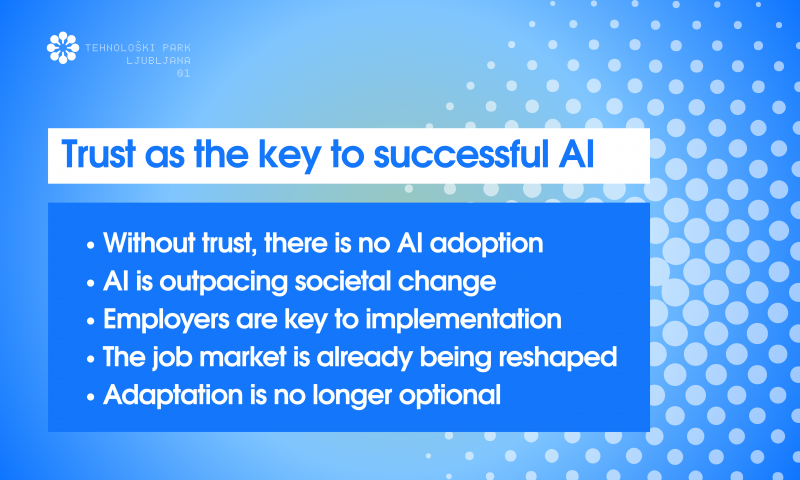
Michael Thompson presented research findings on trust in AI, showing that in many countries skepticism toward AI still outweighs enthusiasm. This is particularly evident in developed Western countries such as the United States, the United Kingdom, and Germany, while developing countries like Brazil and China are significantly more open to AI.
One of the key insights is that people often do not reject AI because of their own negative experiences, but rather due to a broader sense of uncertainty, lack of transparency, and feeling that it is being imposed on them. The main barrier to AI adoption is therefore not necessarily a lack of access or motivation, but above all a lack of trust.
The research also showed a strong link between knowledge and trust. The more people understand AI and its impact, the more likely they are to accept and use it. Personal experience proves to be one of the strongest drivers of trust. Regular users of generative AI often report higher efficiency, better problem-solving abilities, and increased creativity, which helps reduce initial resistance.
The workplace also plays an important role. Thompson emphasized that employers have the greatest legitimacy when it comes to introducing AI. Employees are much more likely to accept change if they see AI as a support tool rather than a threat. It is therefore essential that companies introduce AI in an inclusive way, with clear communication and active involvement of employees.
Rapid technological development and its impact on society
Alex Isaak Horowitz placed the discussion in a broader historical and economic context. He compared AI to major technological turning points such as the Industrial Revolution and electrification, while highlighting a key difference: today’s technology can be deployed almost instantly and without significant physical limitations.
This means that its societal and economic impacts will also be much faster. While the Industrial Revolution gave society decades to adapt, AI-driven changes to the labor market and society will unfold within just a few years.
AI is already transforming many industries. In insurance, it is automating claims processing and risk assessment, while in software development it is taking over a significant share of coding. The result is higher productivity, but also reduced demand for certain roles, especially at entry levels.
This raises important questions about the future of work. We can expect increasing polarization: highly skilled professionals will be in even greater demand, while entry into certain professions may become more difficult. A key challenge will be how young people build their careers if entry-level positions are among the most affected.
The need to adapt society and systems
The discussion also highlighted the need to adapt the education system. Learning will need to become faster and more aligned with new demands, enabling quicker reskilling. At the same time, social and creative skills will become increasingly important.
A broader question was also raised: how will we define work and individual contribution to society in the future? If AI takes over part of today’s tasks, we will need to rethink how people stay included and how we maintain social stability.
Transparency was another important topic. A full technical understanding of AI is not necessary for most people, but clear communication about how it is used, its impact, and accountability is essential.
Conclusion
AI brings significant opportunities in productivity, healthcare, research, and development, but it also raises important questions around trust, employment, and social fairness.
If we want AI to contribute to broader societal progress, technological development must be accompanied by open communication, responsible implementation, and investment in skills and knowledge. Ultimately, trust will be one of the key factors determining how successful this transformation will be.